
Medicinal plant details
Elettaria cardamomum(L.) Maton
(Sukshmaila)
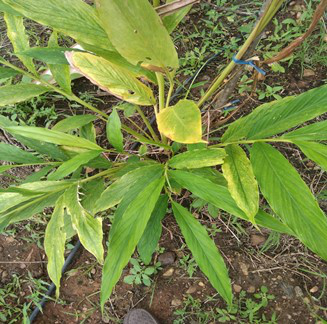
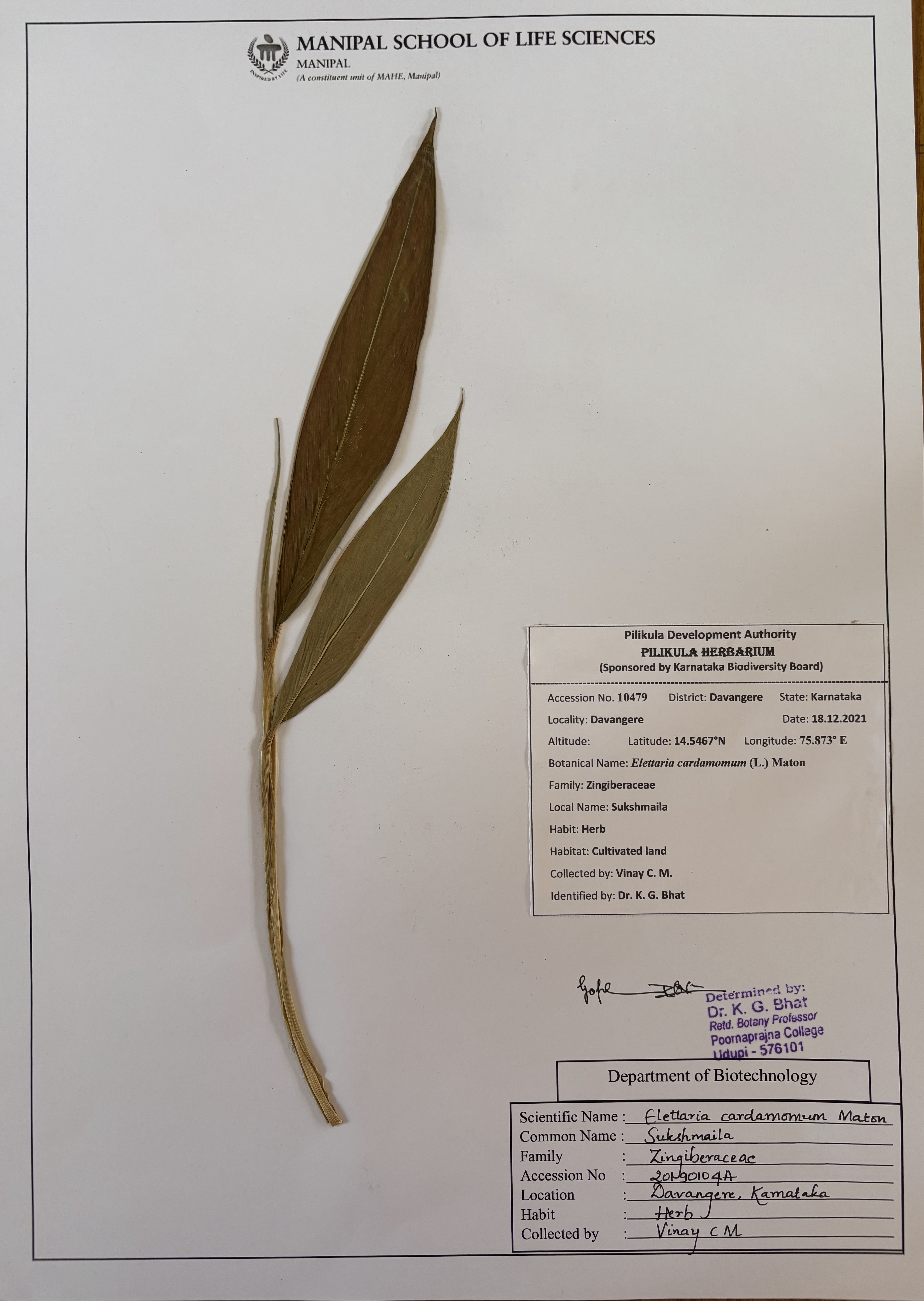
| Common name | Sukshmaila |
| Habit | Herb |
| Habitat | Cultivated |
| Parts used | Fruit |
Synonyms
| Sr. No. | Synonyms |
|---|---|
| 1 | Alpinia cardamomum (L.) Roxb. |
| 2 | Alpinia striata Link |
| 3 | Amomum cardamomum Willd. |
| 4 | Amomum cardamomum L. |
| 5 | Amomum racemosum Lam. |
| 6 | Amomum repens Sonn. |
| 7 | Cardamomum elletari Garsault |
| 8 | Cardamomum malabaricum Pritz. |
| 9 | Cardamomum minus (Gaertn.) Kuntze |
| 10 | Cardamomum officinale Salisb. |
| 11 | Cardamomum verum Oken |
| 12 | Elettaria cardamomum var. minuscula Burkill |
| 13 | Elettaria repens Baill. |
| 14 | Matonia cardamomum (L.) Stephenson & J.M.Churchill |
| 15 | Zingiber minus Gaertn. |
| 16 | Zingiber cardamomum (L.) Stokes |
| 17 | Elettaria cardamomum var. minor Watt |
Taxonomical information
| Kingdom | Viridiplantae |
| Phylum | Streptophyta |
| Class | Magnoliopsida |
| Order | Zingiberales |
| Family | Zingiberaceae |
| Genus | Elettaria |
| Species | Elettaria cardamomum (L.) Maton |
Vernacular names
| Sanskrit | Truti, Ela |
| English | Cardamom |
| Hindi | Choti Ilayachi |
| Kannada | Elakki, Sanna Yalakki |
| Marathi | Velloda, Lahanveldoda, Velchi |
| Malayalam | Elam, Chittelam |
| Bengali | Chota elaich |
| Tamil | Siruelam |
| Telugu | Chinne Elakulu, Sanna Elakulu |
| Urdu | Heel Khurd |
Morphology
It is a herbaceous perennial plant that grows 2–5?m in height, with underground rhizomes and is propagated by vegetative division of rhizomes. The aerial stem is formed by encircling the leaf sheaths. The leaves are 30–35?cm long and 7–10?cm wide, lanceolate with acuminate tip and dark green in colour. Tillers emerge from the axils of underground stems. Most of the vegetative buds are produced during monsoon periods. Inflorescences arise from the rhizomes as a panicle possessing a long cane-like peduncle having nodes and internodes. Normally, 2–4 panicles emerge from the swollen base of tillers and certain cultivars have panicles with multiple branches. Flowers of most cardamom types and varieties are white with the central lip streaked with pink. The flowers are bisexual, irregular and cross-pollination is most common. The labellum is oval and indistinctly 3 lobed. The calyx is tubular, split about ¼ of its length on one side and shortly 3 toothed. The corolla is unequally three lobed with the larger one at the posterior side. The fertile stamen is united without connective appendages, but prolonged into a short crest. The crest is positioned above or below the stigma. Anthers are two lobed, adnate to the filament and dehisce vertically. The size of pollen grains varies from 75 to 120 ?m in diameter. The stigma is funnel shaped with cilia around a small cavity. The ovary is inferior, trilocular with axial placentation and ovules are numerous in each carpel. Anthesis typically starts at 3.30 am and continues until 7.30 am, the maximum pollen bursting occurs between 5.30 am and 6.30 am.
Distribution
It is cultivated in South India at an elevation from 750-1500 m
Medicinal uses
Cough, breething disorders, anorexia, vomiting, urine discharge problems
References
| 1 | Ashokkumar, K., Murugan, M., Dhanya, M. K., and Warkentin, T. D. (2020). Botany, traditional uses, phytochemistry and biological activities of cardamom [Elettaria cardamomum (L.) Maton]–A critical review. Journal of ethnopharmacology, 246, 112244. |