
Medicinal plant details
Boerhavia diffusaL.
(Punarnava)
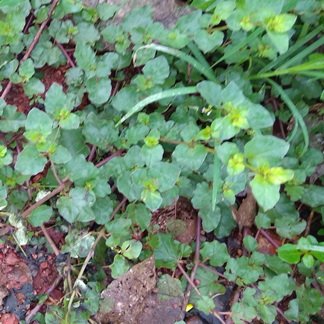
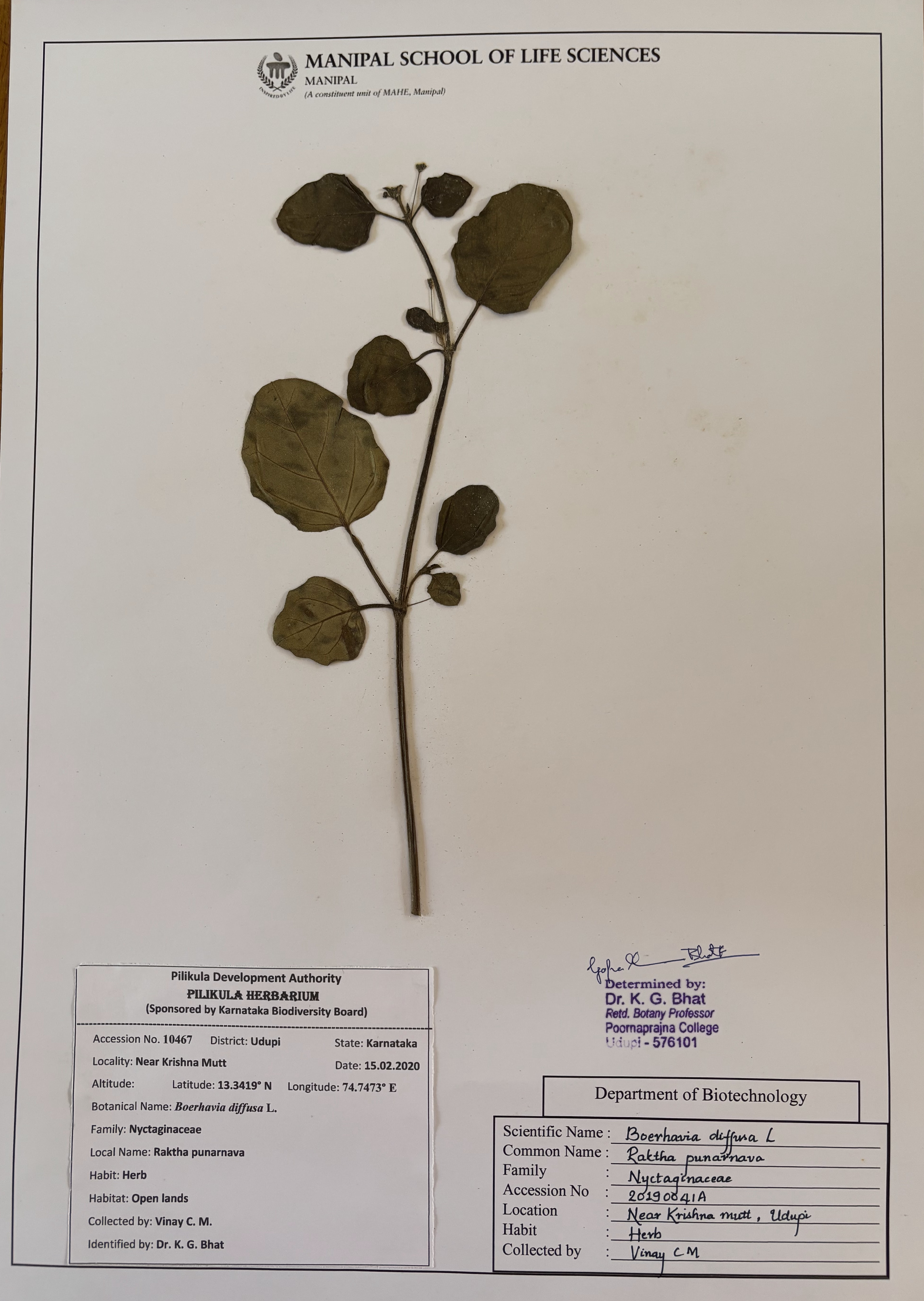
| Common name | Punarnava |
| Habit | Herb |
| Habitat | Growing wild in different terrestrial habitats, ranging from managed grasslands, wastelands, agroecosystems to large forest gaps |
| Parts used | Whole plant |
Synonyms
| Sr. No. | Synonyms |
|---|---|
| 1 | Axia cochinchinensis Lour. |
| 2 | Boerhavia adscendens Willd. |
| 3 | Boerhavia caespitosa Ridl. |
| 4 | Boerhavia ciliatobracteata Heimerl |
| 5 | Boerhavia coccinea var. leiocarpa Standl. |
| 6 | Boerhavia coccinea var. paniculata Moscoso |
| 7 | Boerhavia diffusa var. leiocarpa (Heimerl) C.D.Adams |
| 8 | Boerhavia diffusa var. pubescens Choisy |
| 9 | Boerhavia friesii Heimerl |
| 10 | Boerhavia paniculata Rich. |
| 11 | Boerhavia paniculata f. esetosa Heimerl |
| 12 | Boerhavia paniculata var. guaranitica Heimerl |
| 13 | Boerhavia paniculata f. leiocarpa Heimerl |
| 14 | Boerhavia paniculata var. leiocarpa Heimerl |
| 15 | Boerhavia paniculata f. multiglandulosa ( ex Parodi) Heimerl |
| 16 | Boerhavia paniculata var. subacuta Choisy |
| 17 | Boerhavia repens var. diffusa (L.) Hook.f. |
| 18 | Boerhavia xerophila Domin |
| 19 | Boerhavia diffusa var. paniculata Kuntze |
| 20 | Boerhavia diffusa var. diffusa – |
| 21 | Boerhavia diffusa var. mutabilis (R.Br.) Heimerl |
Taxonomical information
| Kingdom | Viridiplantae |
| Phylum | Streptophyta |
| Class | Magnoliopsida |
| Order | Caryophyllales |
| Family | Nyctaginaceae |
| Genus | Boerhavia |
| Species | Boerhavia diffusa L. |
Vernacular names
| Sanskrit | Punarnava, Varsabhu |
| English | Horse purslene, Hog weed |
| Hindi | Gadapurna, Lalpunarnava |
| Kannada | Kommeberu, Sanadika |
| Marathi | Ghetuli, Satodimula, Punarnava |
| Malayalam | Chuvanna Tazhutawa |
| Bengali | Rakta punarnava |
| Tamil | Mukurattai |
| Telugu | Atikamamidi, Erra galikeru |
| Urdu |
Morphology
It is a perrenial creeping weed, prostrate or ascending herb up to 1 m long or more, having spreading branches, The roots are stout and fusiform with a woody root stock. The stem is prostrate, woody or succulent, cylindrical, often purplish, hairy and thickened at the nodes. Leaves are simple, thick, fleshy and hairy, arranged in unequal pairs, green and glabrous above and usally white underneath; ovate-oblong, round or subcordate at the base with smooth, wavy, or undulate margins; up to 5.5 x 3.3 cm2 in area. Flowers are minute, subcapitate, present 4-10 together in small bracteolate umbels, forming axillary and terminal panicles; hermaphrodite, pedicellate, and pink, or pinkish-red in color; Bracts are deciduous and involucrate; Calyx and corolla replaced by perianth which is tubular in shape, the tube being short and narrow at the base and funnel-shaped at the top and constricted above the ovary. There are five lobes, which are small and acute. Two or three stamens are present and are slightly exserted. The stigma is peltate. The fruit is an achene and is detachable, ovate, oblong, pubescent, fiveribbed and glandular, anthocarpous, and viscid on the ribs.
Distribution
It is found in India, Brazil, Africa, Australia, China, Egypt, Pakistan, Sudan, Sri Lanka, USA, Iran and Middle East countries
Medicinal uses
Anemia, Inflammation
References
| 1 | Babita Agrawal, B. A., Sunanda Das, S. D., and Archana Pandey, A. P. (2011).Boerhaavia diffusa Linn.: A review on its phytochemical and pharmacological profile. Asian J Appl Sci. 4, 663-684. |
| 2 | Nayak, P., and Thirunavoukkarasu, M. (2016). A review of the plant Boerhaavia diffusa: its chemistry, pharmacology and therapeutical potential. J. Phytopharmacol, 5, 83-92. |