
Medicinal plant details
Zingiber officinaleRoscoe
(Shunti)
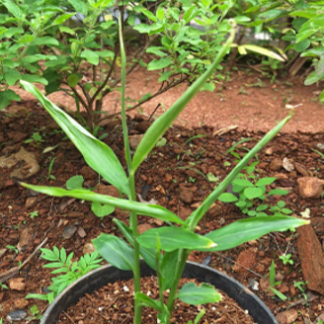
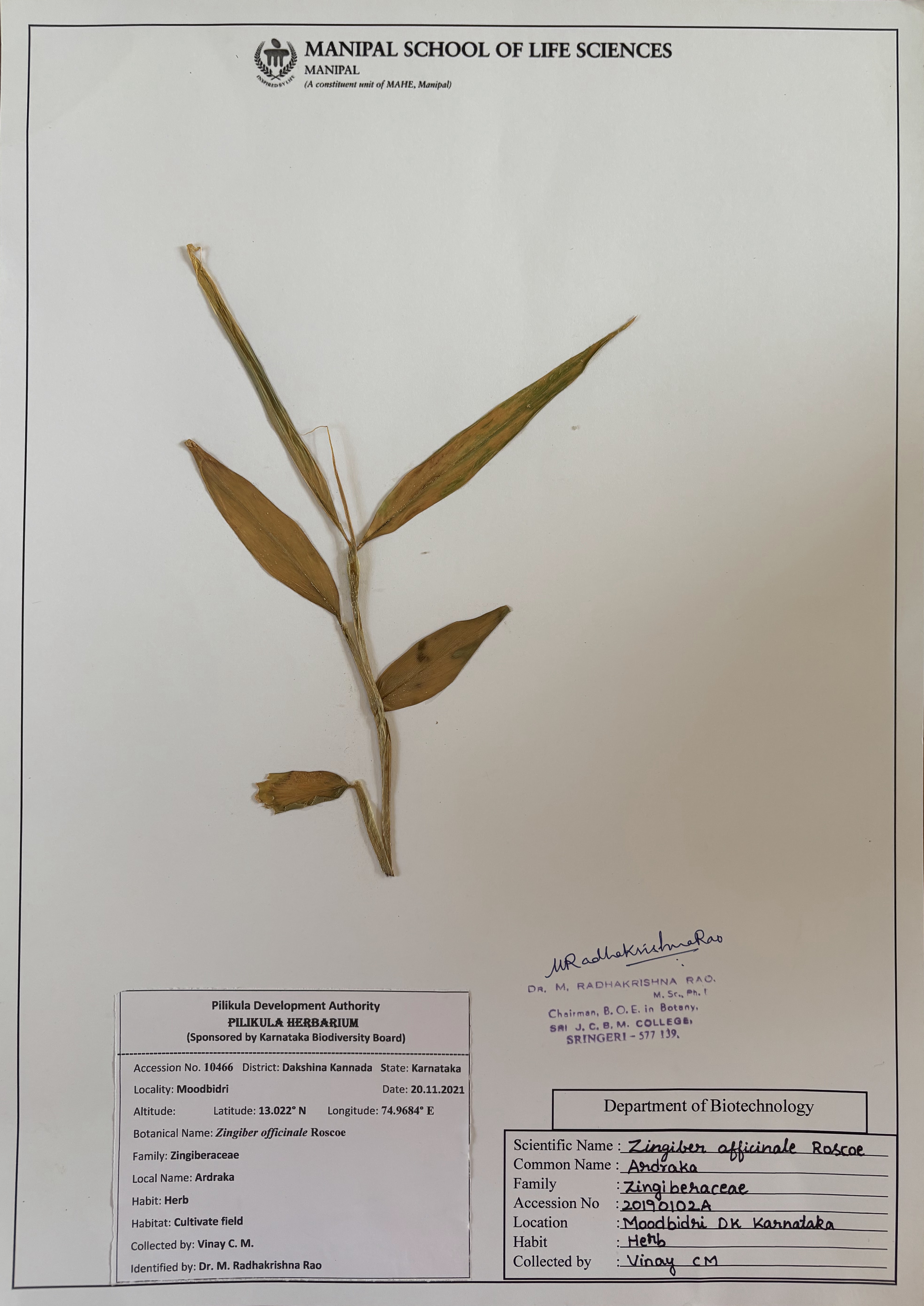
| Common name | Shunti |
| Habit | Herb |
| Habitat | Cultivated |
| Parts used | Rhizome |
Synonyms
| Sr. No. | Synonyms |
|---|---|
| 1 | Amomum angustifolium Salisb. |
| 2 | Amomum zingiber L. |
| 3 | Zingiber aromaticum Noronha |
| 4 | Zingiber blancoi Hassk. |
| 5 | Zingiber officinale f. macrorhizonum (Makino) M.Hiroe |
| 6 | Zingiber officinale f. rubens (Makino) M.Hiroe |
| 7 | Zingiber sichuanense Z.Y.Zhu, S.L.Zhang & S.X.Chen |
| 8 | Zingiber zingiber H.Karst. |
| 9 | Curcuma longifolia Wall. |
| 10 | Zingiber majus Rumph. |
Taxonomical information
| Kingdom | Viridiplantae |
| Phylum | Streptophyta |
| Class | Magnoliopsida |
| Order | Zingiberales |
| Family | Zingiberaceae |
| Genus | Zingiber |
| Species | Zingiber officinale Roscoe |
Vernacular names
| Sanskrit | Ardraka, Katubhadra |
| English | Ginger |
| Hindi | Adarakha |
| Kannada | Alla, Hasishunti |
| Marathi | Ardrak, Ale |
| Malayalam | Inchi |
| Bengali | Ada |
| Tamil | Injee, Allam |
| Telugu | Allamu, Allam |
| Urdu | Adrak |
Morphology
It is a rhizomatous perennial herb, reaching up to 90 cm in height under cultivation. Rhizomes are aromatic, thick lobed, pale yellowish, bearing simple alternate distichous narrow oblong lanceolate leaves. Leaves are long, 2-3 cm broad with sheathing bases, the blade gradually tapering to a point. Inflorescence soilitary, lateral radical pedunculate, oblong cyclindrical spikes. Flowers are rare, rather small, calyx superior, gamosepalous, three toothed, open splitting on side, corolla of three subequal oblong to lanceolate connate greenish segments.
Distribution
It is cultivated in India, China, Nigeria, Indonesia, Bangladesh, Thailand, Philippines, Jamaica, Austrailia, UK, US, Japan and Saudi Arabia
Medicinal uses
Constipation, pain, inflammation and throat disorders
References
| 1 | Mishra, R. K., Kumar, A., and Kumar, A. (2012). Pharmacological activity of Zingiber officinale. International Journal of pharmaceutical and chemical sciences, 1, 1073-1078. |
| 2 | Dhanik, J., Arya, N., and Nand, V. (2017). A review on Zingiber officinale. Journal of Pharmacognosy and phytochemistry, 6, 174-184. |