
Medicinal plant details
Woodfordia fruticosaKurz
(Dhataki)
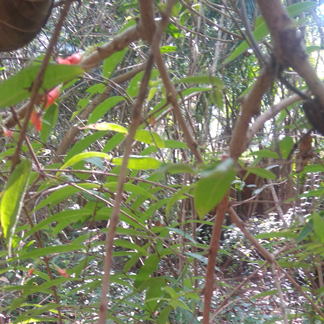
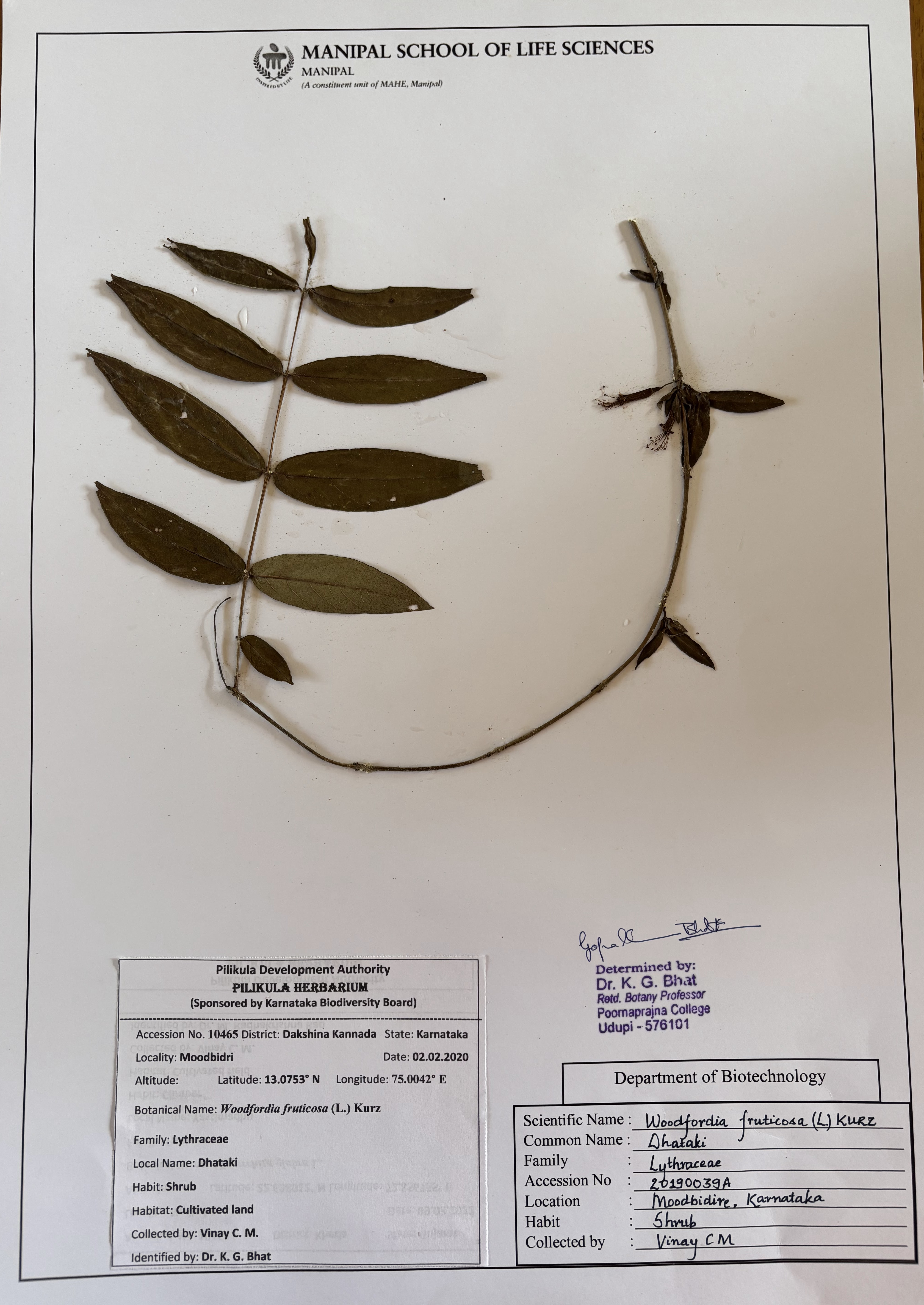
| Common name | Dhataki |
| Habit | Shrub |
| Habitat | Cultivated; Waste lands |
| Parts used | Flower |
Synonyms
| Sr. No. | Synonyms |
|---|---|
| 1 | Lythrum punctatum Span. |
| 2 | Woodfordia floribunda Salisb. |
| 3 | Acistoma coccineum Zipp. ex Span. |
| 4 | Grislea punctata Buch.-Ham. ex Sm. |
| 5 | Grislea tomentosa Roxb. |
| 6 | Lythrum fruticosum L. |
| 7 | Woodfordia tomentosa Bedd. |
| 8 | Lythrum hunteri DC. |
Taxonomical information
| Kingdom | Viridiplantae |
| Phylum | Streptophyta |
| Class | Magnoliopsida |
| Order | Myrtales |
| Family | Lythraceae |
| Genus | Woodfordia |
| Species | Woodfordia fruticosa Kurz |
Vernacular names
| Sanskrit | Bahupuspi, Tamrapuspi, Vahnijvala |
| English | Fire flame bush |
| Hindi | Dhai, Dhava |
| Kannada | Dhataki, Tamrapushpi |
| Marathi | Dhayati, Dhavati |
| Malayalam | Tattiripuvu, Tatire |
| Bengali | Dhaiphul |
| Tamil | Kattati, Kattathi, Kattattipoo |
| Telugu | Aarl Puruvu |
| Urdu |
Morphology
It is an evergreen bushy shrub grows upto 5 m tall with spreading stems. Leaves are in a cluster at a point, sub-sessile, 4-11X 2-4 cm, ovate or lanceolate, grey, pubescent beneath, sometimes glabrous. Flowers are crimson, 2-16 flowered axillary cymes, pedicels to 1 cm long. Calyx 1-1.5 cm long, bright red, tubular. Petals are longer than calyx teeth. Fruits capsule with 1 cm in size. Seeds are light brown, numerous and trigonous-ovoid
Distribution
It is found in India such as eastern parts of Ravi in Himalaya upto 1400 m altitude, Mel ghat, upper part of Godawari, and in Rajputana areas. It is also found in other countries such as Ceylon, Baluchistan, Tropical Africa, China, Japan, Summatra, and Java
Medicinal uses
Diarrhoea, thirst, erysepales, ulcer, bleeding disorder
References
| 1 | Rani, S., Rahman, K., Younis, M., and Basar, S. N. (2015). Dhawa (Woodfordia fruticosa (L.) Kurz.): A Versatile Medicinal Plant. International Journal of Pharmaceutical Sciences and Drug Research. 7, 315-320. |
| 2 | Kumar, D., Sharma, M., Sorout, A., Saroha, K., and Verma, S. (2016). Woodfordia fruticosa Kurz.: a review on its botany, chemistry and biological activities. Journal of pharmacognosy and phytochemistry, 5, 293-298. |