
Medicinal plant details
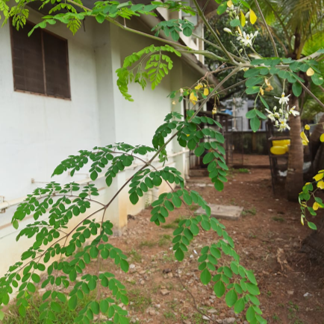
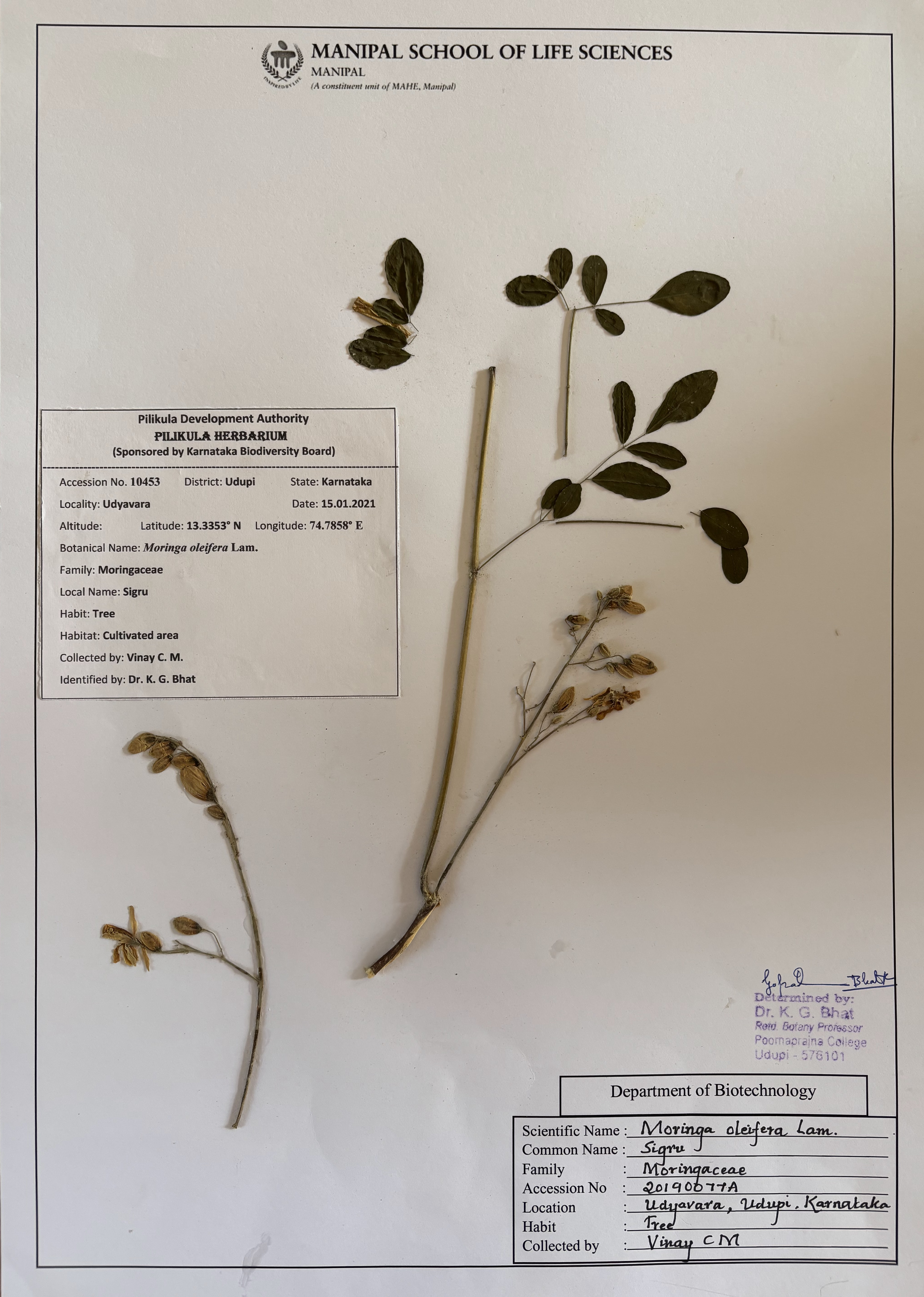
Moringa oleiferaLam.
(Sigru)
| Common name | Sigru |
| Habit | Tree |
| Habitat | Cultivated |
| Parts used | Whole plant |
Synonyms
| Sr. No. | Synonyms |
|---|---|
| 1 | Moringa nux-eben Desf. |
| 2 | Moringa erecta Salisb. |
| 3 | Moringa edulis Medik. |
| 4 | Moringa domestica Buch.-Ham. |
| 5 | Moringa amara Durin |
| 6 | Moringa robusta Bojer |
| 7 | Moringa sylvestris Buch.-Ham. |
| 8 | Moringa octogona Stokes |
| 9 | Moringa polygona DC. |
| 10 | Hyperanthera decandra Willd. |
| 11 | Guilandina moringa L. |
| 12 | Moringa zeylanica Pers. |
| 13 | Hyperanthera moringa (L.) Vahl |
Taxonomical information
| Kingdom | Viridiplantae |
| Phylum | Streptophyta |
| Class | Magnoliopsida |
| Order | Brassicales |
| Family | Moringaceae |
| Genus | Moringa |
| Species | Moringa oleifera Lam. |
Vernacular names
| Sanskrit | Sobhanjana, Bahala, Tiksnagandha, Aksiva, Mocaka |
| English | Horse Radish tree, Drum-stick tree |
| Hindi | Sahajan |
| Kannada | Neegge, Nugge kand chakke |
| Marathi | Sevaga, Segat sala |
| Malayalam | Muringa |
| Bengali | Sajina, Sajna |
| Tamil | Munaga, Mulaga |
| Telugu | Munaga, Mulaga |
| Urdu | Sohanjana, Sahajan |
Morphology
It is a small to medium sized tree grows upto 12m in height and 20-40 cm diameter at chest height. It has fragile branches, thick, corky and whitish bark. Leaves are bipinnate or tripinnate grows upto 45 cm long. Leaves are compound with green to dark green leaflets of 1-2 cm long. Leaflets are rounded or blunt pointed at the apex and short pointed at base with entire margin. Flowers are yellowish white borne on slender, hairy stalks in axillary, divaricate panicles, 10-25 cm long. Individual flowers are approximately 1 cm long and 2 cm broad with five-reflexed sepals and five petals and a pistil composed of one celled ovary. Fruits are trilobed capsules about 30-120 cm long. Immature pods are green and matured ones are brown in colour. Seeds are round with brownish semipermeable seed hull, 3 papery wings. Seed hulls are brown to black in colour and white sometimes if kernals are of low viability
Distribution
It is indigenous to South Asia, grows in the Himalayan foothills from North eastern Pakistan to North eastern West Bengal, India. It is cultivated in in other parts of Pakistan, India, Nepal, Afganistan, Bangladesh, Sri Lanka, Arabian peninsula, East and West Africa, Central and South America. Within India, it is cultivated in Assam, Bihar, Madhya pradesh, Maharasthra, Karnataka, Odisha, Punjab, Rajasthan, and Uttar Pradesh
Medicinal uses
Helminthiasis, obesity, splenic disease, abscess, abdominal lump, goitre, inflammation, tumor, erysepales, ulcer, stone formation, urinary disease, skin disease, chest injury, diseases of ear, internal abscesses
References
| 1 | Shamim, S. A., and Fatima, L. (2018). Medicinal properties of Moringa oleifera (Sahajana): A review. The Pharma Innovation J, 7, 311-316. |
| 2 | Ritu Paliwal, R. P., Veena Sharma, V. S., and Pracheta, P. (2011). A review on horse radish tree (Moringa oleifera): A multipurpose tree with high economic and commercial importance. Asian journal of Biotechnology. 3, 317-328. |