
Medicinal plant details
Pleurolobus gangeticus(L.) J.St.-Hil. ex H.Ohashi & K.Ohashi
(Shalaparni)
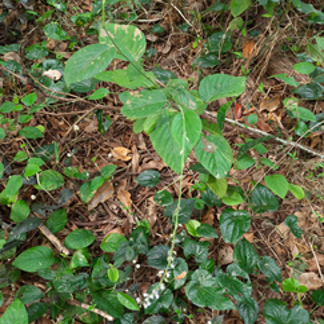
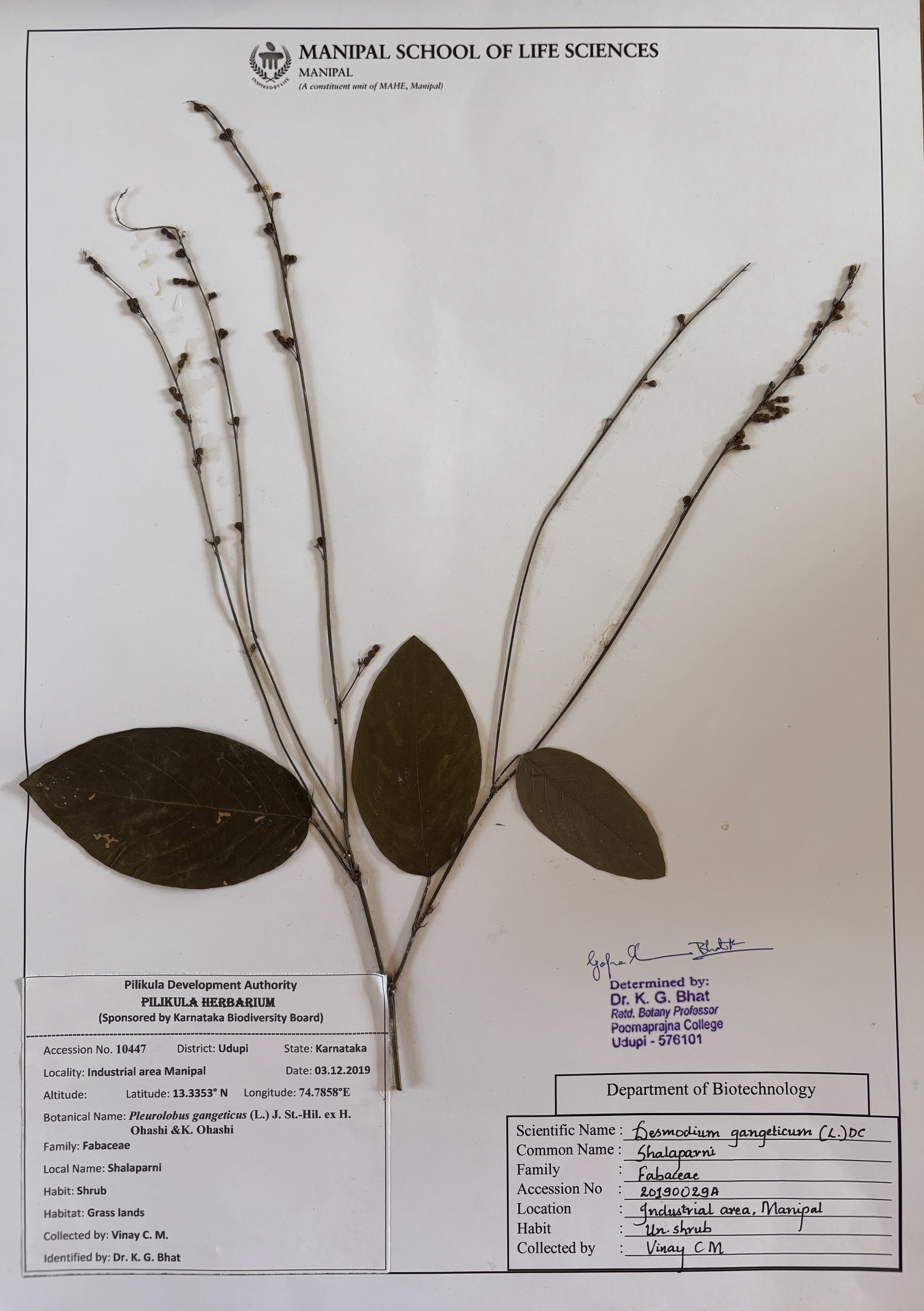
| Common name | Shalaparni |
| Habit | Shrub |
| Habitat | Moist deciduous forests and forest plantations, also in the plains |
| Parts used | Root |
Synonyms
| Sr. No. | Synonyms |
|---|---|
| 1 | Desmodium cavaleriei H.Lev. |
| 2 | Meibomia gangetica (L.) Kuntze |
| 3 | Hedysarum collinum Roxb. |
| 4 | Meibomia polygonodes (Welw. ex Baker) Kuntze |
| 5 | Pleurolobus maculatus J.St.-Hil. |
| 6 | Hedysarum gangeticum L. |
| 7 | Hedysarum maculatum L. |
| 8 | Hedysarum ochroleucum Moench |
| 9 | Desmodium lanceolatum (Schumach. & Thonn.) Walp. |
| 10 | Desmodium polygonoides Welw. ex Baker |
| 11 | Desmodium gangeticum (L.) DC. |
| 12 | Hedysarum lanceolatum Schum. & Thonn. |
| 13 | Desmodium gangeticum var. maculatum (L.) Baker |
| 14 | Desmodium natalitium Sond. |
| 15 | Desmodium maculatum (L.) DC. |
| 16 | Hedysarum pseudogangeticum Miq. |
| 17 | Aeschynomene gangetica (L.) Poir. |
| 18 | Aeschynomene maculata Poir. |
| 19 | Desmodium gangeticum var. ramnagari Haines |
| 20 | Desmodium latifolium Wight |
| 21 | Hedysarum lanceolatum Schumach. & Thonn. |
| 22 | Desmodium cavaleriei H.Lev. |
| 23 | Meibomia natalita (Sond.) Kuntze |
| 24 | Hedysarum collinum Roxb. |
| 25 | Desmodium collinum Wight |
| 26 | Hedysarum roseum Blume ex Miq. |
| 27 | Hedysarum styracifolium Roxb. ex Wight & Arn. |
Taxonomical information
| Kingdom | Viridiplantae |
| Phylum | Streptophyta |
| Class | Magnoliopsida |
| Order | Fabales |
| Family | Fabaceae |
| Genus | Pleurolobus |
| Species | Pleurolobus gangeticus (L.) J.St.-Hil. ex H.Ohashi & K.Ohashi |
Vernacular names
| Sanskrit | Sthira, Vidarigandha, Amsumati |
| English | |
| Hindi | Sarivan, Salaparni |
| Kannada | Murelchonne |
| Marathi | Salparni, Salwan |
| Malayalam | Moovila |
| Bengali | Salparni |
| Tamil | Moovilai |
| Telugu | Nakkotokaponna, Kolaponna, Kolakuponna |
| Urdu |
Morphology
It is slender, subshrub grows up to 1.2 m tall. Stem is woody, irregularly angled, clothed with short grey hairs. Leaves are alternate, unifoliate, ovate to elliptic, apex acute, petioles 1-2 cm long, stipules 8 mm long, linear-lanceolate. Flowers are white to red or purple or in combination, fascicled in terminal or axillary, 15-25 cm long racemes. Fruits are compressed and stalkless, up to 7-8 jointed. Seeds are compressed reniform without strophiole
Distribution
Growing wild throughout India and spreads east to Pegu and Ceylon, the Malay Peninsula and Archipelago, and is distributed to China, the Philippine Islands and tropical Africa
Medicinal uses
Fever, Metabolic disorders, piles, emesis, respiratory diseases, asthma, curing cough, helminthiasis, tuberculosis, diseases of eye, heart problems, hypertension
References
| 1 | Deshpande, H. A., and Bhalsing, S. R. (2014). A Review of Phytochemical Profile of Desmodium gangeticum (L.) DC: A Valued Endangered Medicinal Plant. International Journal of Pharma Research and Health Sciences, 1, 1-12. |
| 2 | Singh, S., Parmar, N., and Patel, B. (2015). A review on Shalparni (Desmodium gangeticum DC.) and Desmodium species (Desmodium triflorum DC. & Desmodium laxiflorum DC.)–Ethnomedicinal perspectives. J Medicinal Plants, 3, 38-43. |