
Medicinal plant details
Myristica fragransHoutt.
(Jatiphala)
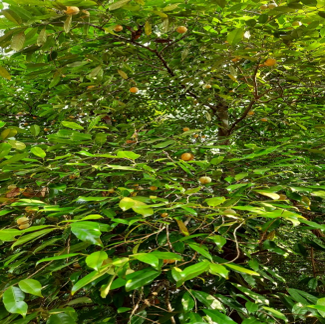
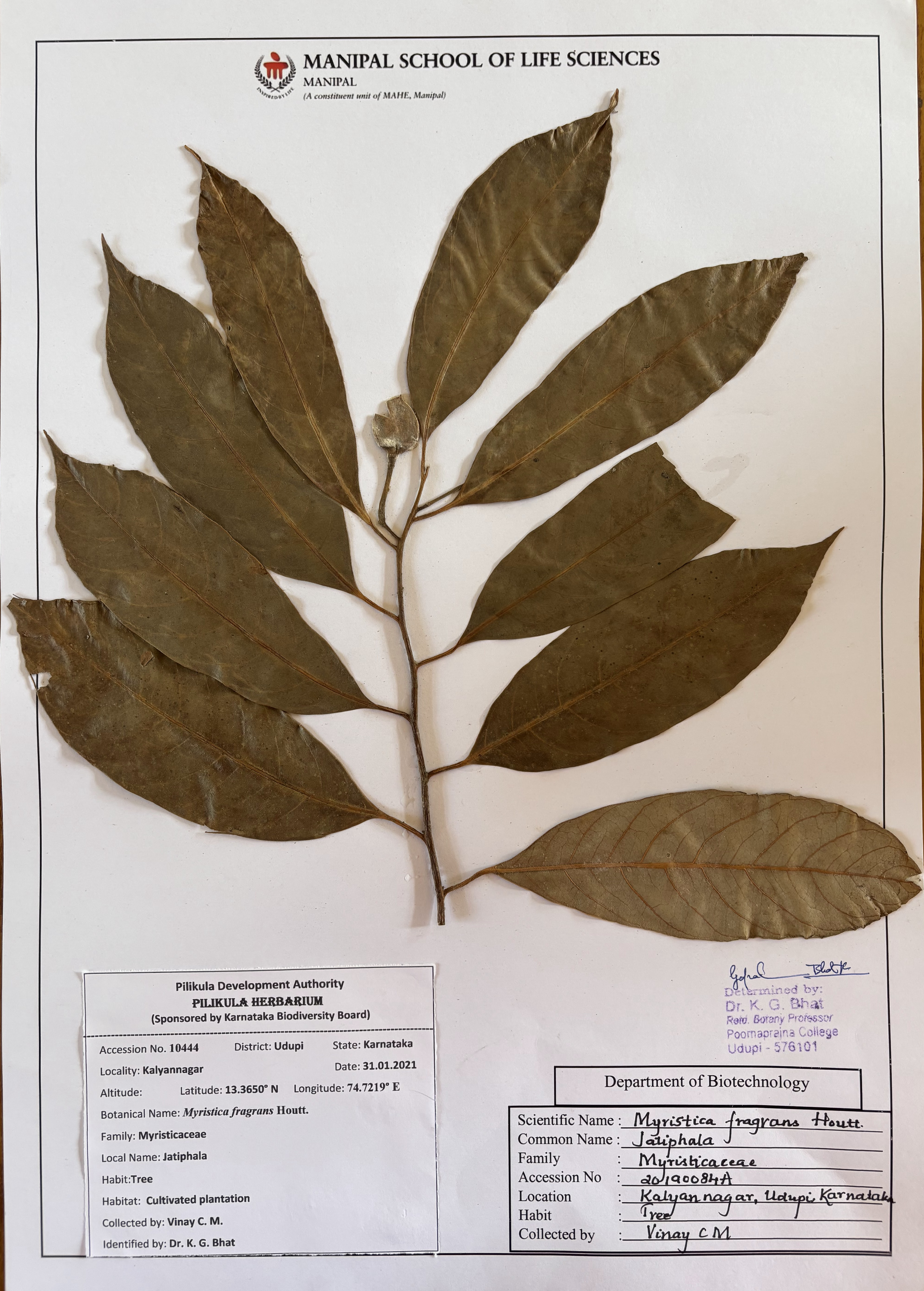
| Common name | Jatiphala |
| Habit | Tree |
| Habitat | Cultivated, lowland forest |
| Parts used | Seed |
Synonyms
| Sr. No. | Synonyms |
|---|---|
| 1 | Myristica amboinensis Gand. |
| 2 | Myristica aromatica Sw. |
| 3 | Myristica philippinensis Gand. |
| 4 | Myristica laurella Gand. |
| 5 | Myristica moschata Thunb. |
| 6 | Myristica officinalis L.f. |
| 7 | Palala fragrans (Houtt.) Kuntze |
| 8 | Aruana silvestris Burm.f. |
| 9 | Myristica aromatica Lam. |
Taxonomical information
| Kingdom | Viridiplantae |
| Phylum | Streptophyta |
| Class | Magnoliopsida |
| Order | Magnoliales |
| Family | Myristicaceae |
| Genus | Myristica |
| Species | Myristica fragrans Houtt. |
Vernacular names
| Sanskrit | Jatisasya, Jatiphala |
| English | Nutmeg |
| Hindi | Jaiphal |
| Kannada | Jadikai, Jaykai, Jaidikai |
| Marathi | Jaiphal |
| Malayalam | Jatika |
| Bengali | Jaiphala, Jaitri |
| Tamil | Sathikkai, Jathikkai, Jatikkai, Jadhikai, Jadhikkai |
| Telugu | Jajikaya |
| Urdu | Jauzbuwa, Jaiphal |
Morphology
It is a perennial tree grows up to a height of 20 m. Bark is brown-red coloured, soft and smooth. Leaves 5-15 cm X 2 to 7 cm in size and alternately arranged on the branches. Leaves are shiny on top portion, leaf veins are pinnate and free and blades are densely pubescent. Branching pattern is horizontal radiating in whorls from the trunk. Flowers are unisexual, composed of 3-4 sepals that are fused. Female flowers up to 1 cm long and are unicarpellate, uniovulate and form in a groups of 1-3, while male flowers are up to 7 mm long and form in a groups of 1-10. Occasionally, both male and female flowers present in the same tree. Fruits are yellow colored, with single seed present. Outside of the seed is covered with bright-red, fringed eshy, leathery coating
Distribution
Globally found in India, South East Asia, North Australia, and Pacific islands. Natively it is found in the Moluccas in east Indonesia
Medicinal uses
Diarrhoea, malabsorption syndrome, emesis, dryness of mouth, chronic rhinitis, cough, asthma, seminal diabetes
References
| 1 | Smith, A. C., and collaboration of RP Wodehouse. (1937). The American species of Myristicaceae. Brittonia, 2, 393-510. |
| 2 | Armstrong, J. E. (1997). Pollination by deceit in nutmeg (Myristica insipida, Myristicaceae): floral displays and beetle activity at male and female trees. American Journal of Botany, 84, 1266-1274. |
| 3 | De Wilde, W. J. J. O. (1991). The genera of Myristicaceae as distinguished by their inflorescences, and the description of a new genus, Bicuiba. Beiträge zur Biologie der Pflanzen, 66, 95-125. |
| 4 | Arumugam, G., Purushotham, B., and Swamy, M. K. (2019). Myristica fragrans Houtt.: botanical, pharmacological, and toxicological aspects. Natural Bio-active Compounds: Volume 2: Chemistry, Pharmacology and Health Care Practices, 81-106. |
| 5 | Malhotra, S. K., and Peter, K. V. (2012). Handbook of herbs and spices. Woodhead Publishing Series in Food Science, Technology and Nutrition. 2nd ed. Cambridge, UK: Woodhead Publishing, 2. |
| 6 | Thangaselvabai, T., Sudha, K. R., Selvakumar, T., and Balakumbahan, R. (2011). Nutmeg (Myristica fragrans Houtt)-the twin spice-a review. Agricultural Reviews, 32, 283-293. |