
Medicinal plant details
Phyllanthus urinariaL.
(Tamalaki)
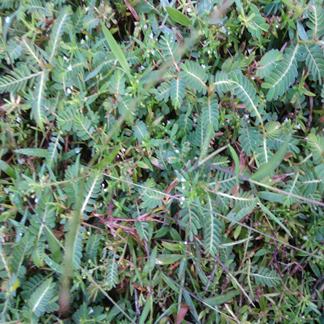
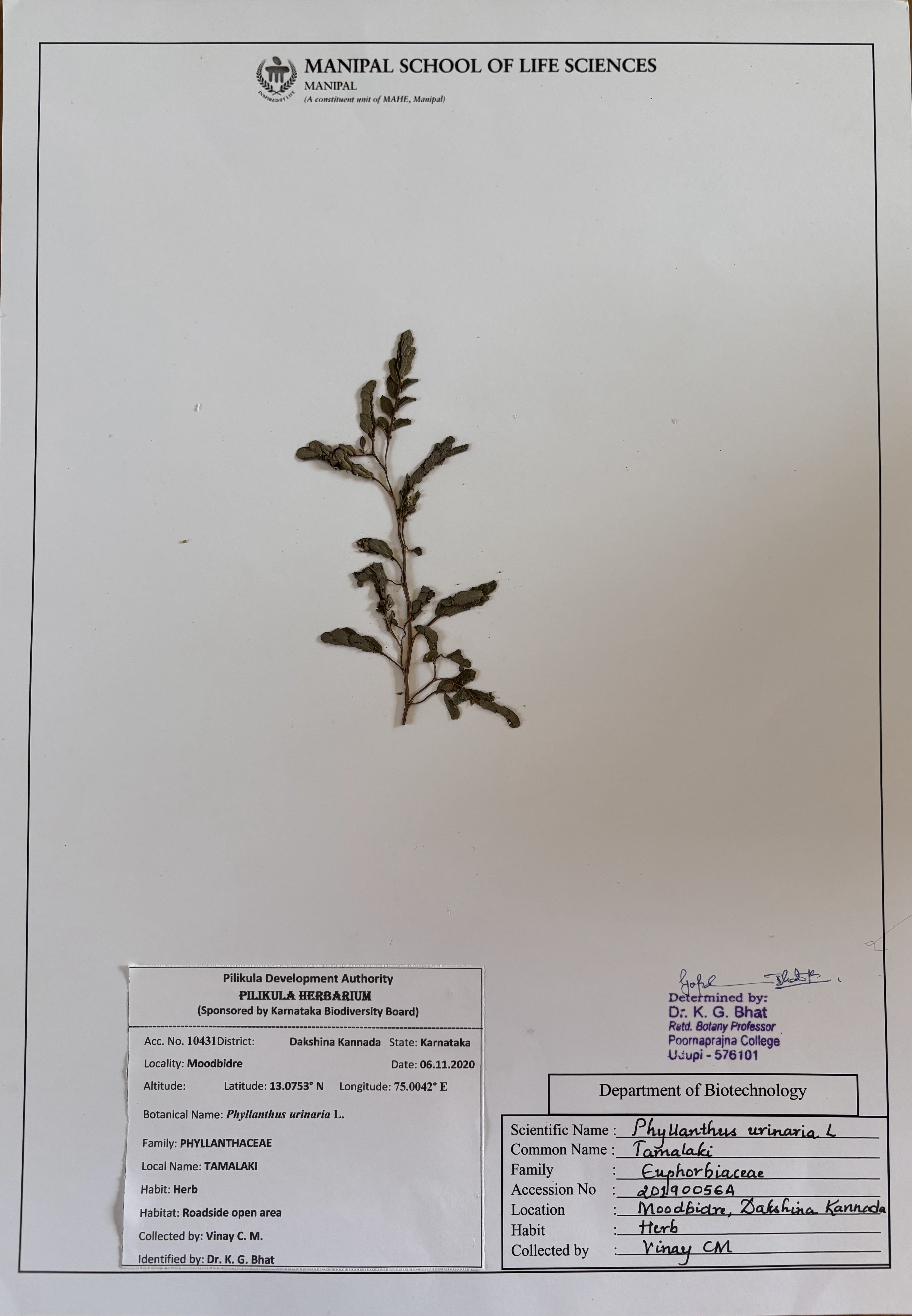
| Common name | Tamalaki |
| Habit | Herb |
| Habitat | Sunny areas, shady places, in the plains, and in degraded deciduous forests |
| Parts used | Whole plant |
Synonyms
| Sr. No. | Synonyms |
|---|---|
| 1 | Phyllanthus echinatus Buch.-Ham. ex Wall. |
| 2 | Phyllanthus muricatus Wall. |
| 3 | Phyllanthus verrucosus Elmer |
| 4 | Phyllanthus urinaria var. oblongifolius Mull.Arg. |
| 5 | Phyllanthus urinaria var. laevis Haines |
| 6 | Diasperus urinaria (L.) Kuntze |
Taxonomical information
| Kingdom | Viridiplantae |
| Phylum | Streptophyta |
| Class | Magnoliopsida |
| Order | Malpighiales |
| Family | Phyllanthaceae |
| Genus | Phyllanthus |
| Species | Phyllanthus urinaria L. |
Vernacular names
| Sanskrit | Bhumyamalaki |
| English | Chamber bitter, Stone-breaker herb |
| Hindi | Hajarmani, lal bhuinanwalah |
| Kannada | Kempu kirunelli, Kempu nelanelli |
| Marathi | Laal bhooyiavali |
| Malayalam | Chirukizhukanelli |
| Bengali | Hazarmani |
| Tamil | Civappu kilanelli |
| Telugu | Erra Usirika |
| Urdu |
Morphology
Erect annual herb. Leaves upto 2 x 0.5 cm, sessile, closely placed and often overlapping, oblong or obovate, apiculate; stipules subulate. Male flowers pedicellate, in axillary fascicles; female flowers axillary, solitary, subsessile. Calyx-lobes 5-6, elliptic-oblong. Stamens-3; filaments connate. Capsules 2-2.5 mm across, verrucose. Seeds transversely ridged
Distribution
Distributed globally in tropical regions such as India, Sri Lanka, Indochina, Japan, Malaysia, Indonesia and United States. Within India, locally distributed in Assam, Kerala
Medicinal uses
Treatment of liver damage, hepatitis, jaundice, renal disorders, enteritis, diarrhea and dropsy
References
| 1 | Vattakaven, T., George, R. M., Balasubramanian, D., Rejou-Mechain, M., Muthusankar, G., Ramesh, B. R., and Prabhakar, R. (2016). India Biodiversity Portal: An integrated, interactive and participatory biodiversity informatics platform. Biodiversity Data Journal, 4, e10279. |
| 2 | Bhat, K. G. (2003). Flora of Udupi. Indian Naturalist. |
| 3 | Du, G., Xiao, M., Yu, S., Wang, M., Xie, Y., and Sang, S. (2018). Phyllanthus urinaria: a potential phytopharmacological source of natural medicine. Int J Clin Exp Med, 11, 6509-6520. |