
Medicinal plant details
Moeroris amara(Schumach. & Thonn.) R.W.Bouman
(Tamalaki)
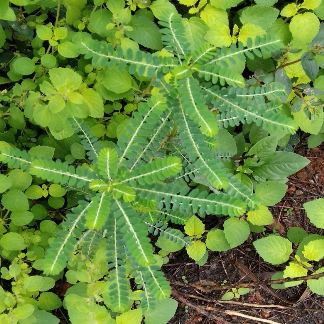
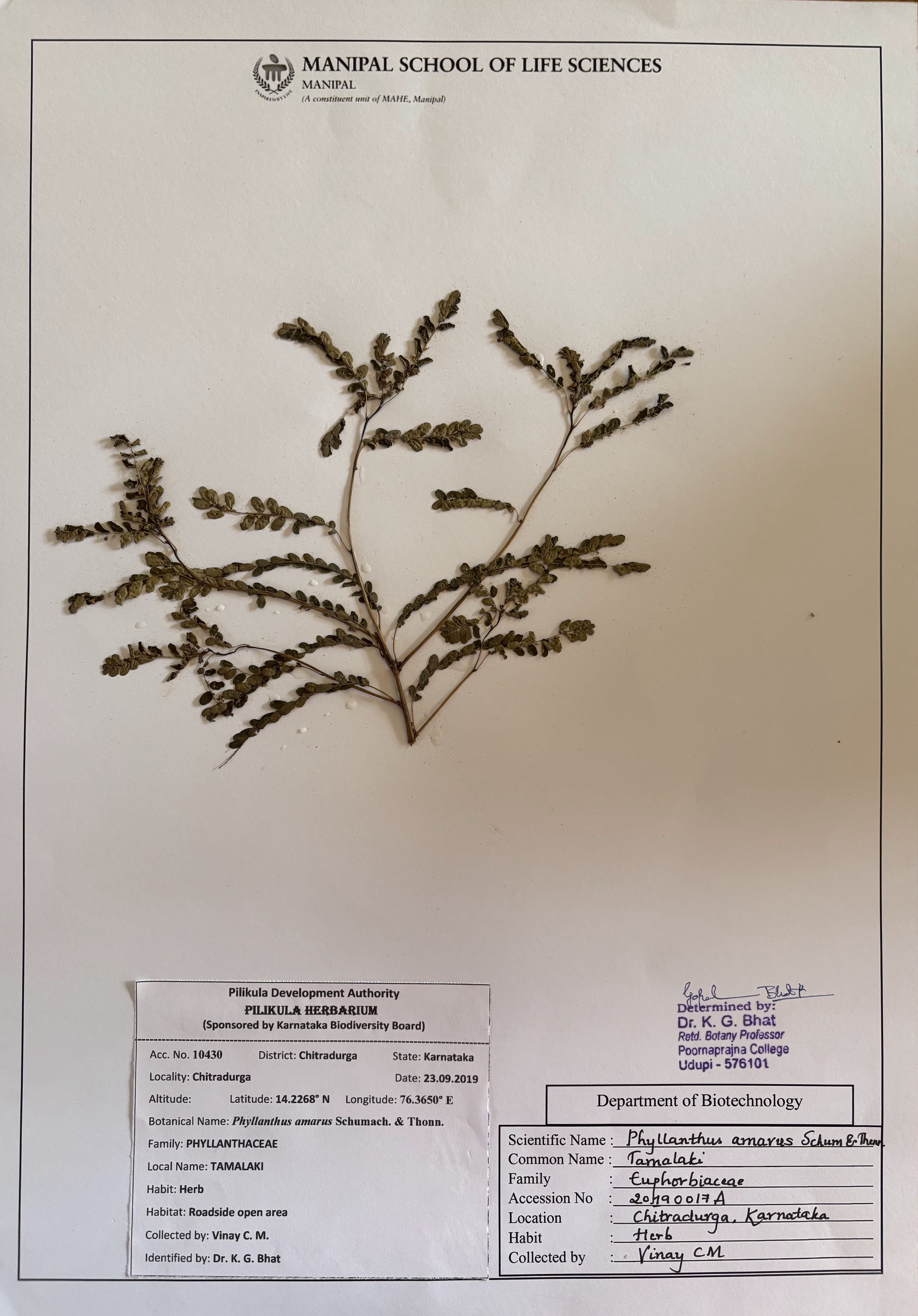
| Common name | Tamalaki |
| Habit | Herb |
| Habitat | Degraded moist deciduous, forest plantations and also in plains |
| Parts used | Whole plant |
Synonyms
| Sr. No. | Synonyms |
|---|---|
| 1 | Phyllanthus amarus var. baronianus Leandri |
| 2 | Phyllanthus nanus Hook.f. |
| 3 | Phyllanthus niruri var. amarus (Schumach. & Thonn.) Leandri |
| 4 | Phyllanthus niruri var. scabrellus (Webb) Mull.Arg. |
| 5 | Phyllanthus scabrellus Webb |
| 6 | Phyllanthus swartzii Kostel. |
| 7 | Diasperus nanus (Hook.f.) Kuntze |
| 8 | Phyllanthus niruri var. genuinus Mull.Arg. |
| 9 | Phyllanthus amarus subsp. amarus |
Taxonomical information
| Kingdom | Viridiplantae |
| Phylum | Streptophyta |
| Class | Magnoliopsida |
| Order | Malpighiales |
| Family | Phyllanthaceae |
| Genus | Phyllanthus |
| Species | Moeroris amara (Schumach. & Thonn.) R.W.Bouman |
Vernacular names
| Sanskrit | Bhoomyaamlakee, Bhoodhatree, Tamalakee |
| English | Carry me seed, stone breaker, wind breaker |
| Hindi | Bhumi amla, Jangli amli |
| Kannada | Nela-nelli, Kirunelli |
| Marathi | Bhuiawali |
| Malayalam | Keezhanelli |
| Bengali | Bhui amla |
| Tamil | Keelanelli |
| Telugu | Nela usiraka |
| Urdu | Bhumi amla |
Morphology
Slender herb is 30-60 cm tall. Leaves 6-8 x 3-4 mm in size, elliptic-oblong, apex obtuse to acute, rounded base. Flowers are small with 5 tepals. Fruits are globose like capsules underneath the branches and seeds are trigonous, vertically muriculate, 1 mm long with 6 ribs on the back
Distribution
Globally it has been found in Philippine, Cuba, Nigeria and India. Within India, it is found throughout the warmer parts of India
Medicinal uses
Diarrhea, Dysentery, Dropsy, Jaundice, Intermittent fevers, urinogenital disorders, scabies and wounds
References
| 1 | Meena, J., Sharma, R. A., and Rolania, R. (2018). A review on phytochemical and pharmacological properties of Phyllanthus amarus Schum. and Thonn. International journal of Pharmaceutical sciences and Research, 9, 1377-1386. |
| 2 | Verma, S., Sharma, H., and Garg, M. (2014). Phyllanthus amarus: A review. Journal of pharmacognosy and Phytochemistry, 3, 18-22. |