
Medicinal plant details
Phyllanthus emblicaL.
(Amalaki)
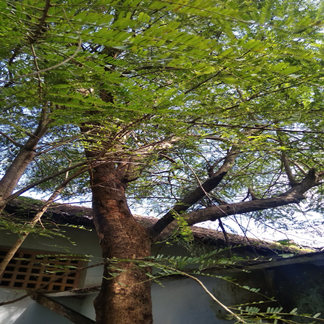
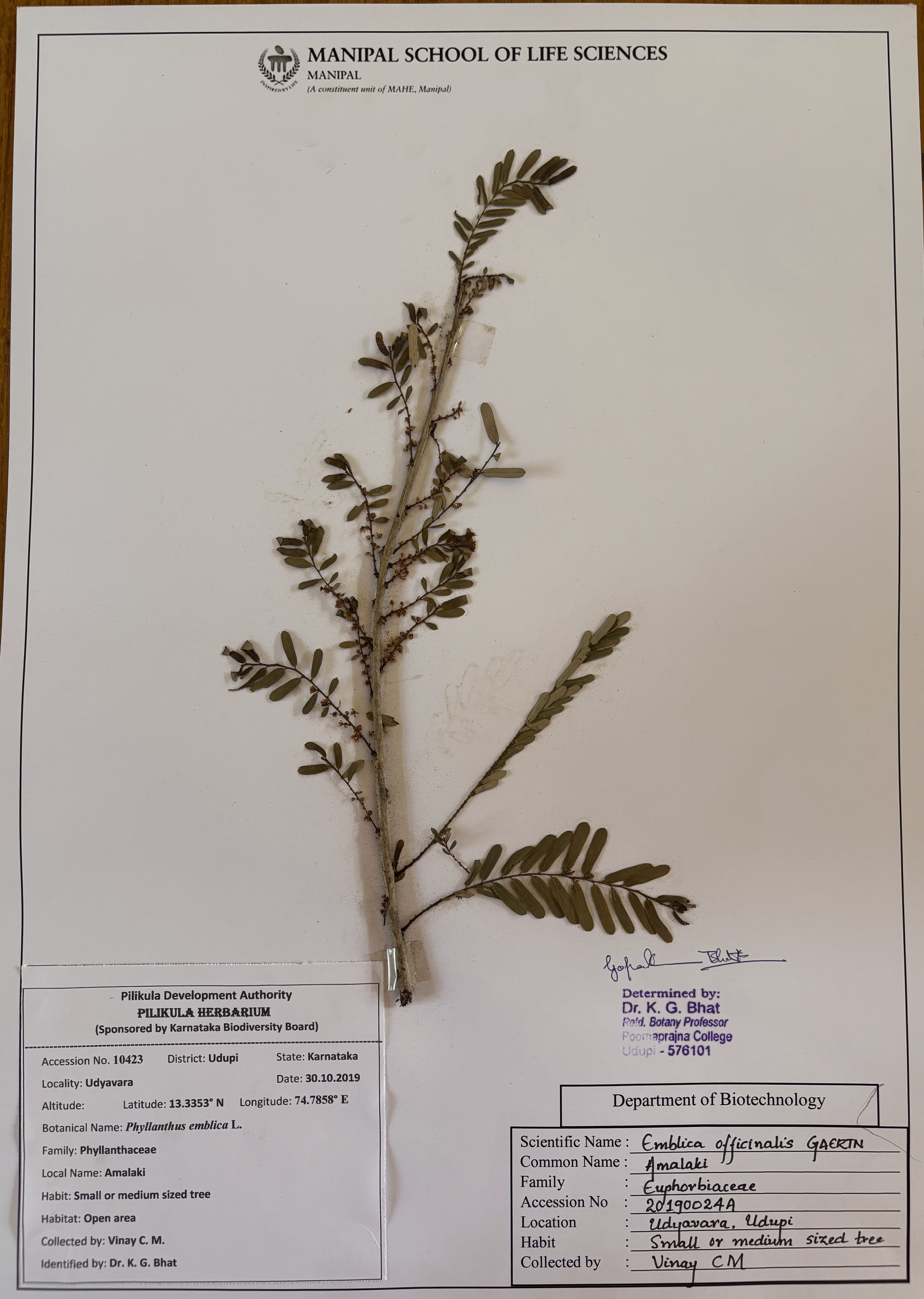
| Common name | Amalaki |
| Habit | Tree |
| Habitat | Dry and moist deciduous forests, also cultivated in the plains |
| Parts used | Fruit |
Synonyms
| Sr. No. | Synonyms |
|---|---|
| 1 | Phyllanthus glomeratus Roxb. ex Wall. |
| 2 | Phyllanthus mairei H.Lev. |
| 3 | Phyllanthus mimosifolius Salisb. |
| 4 | Phyllanthus pomiferus Hook.f. |
| 5 | Phyllanthus taxifolius D.Don |
| 6 | Cicca emblica (L.) Kurz |
| 7 | Cicca macrocarpa Kurz |
| 8 | Diasperus emblica (L.) Kuntze |
| 9 | Diasperus pomiferus (Hook.f.) Kuntze |
| 10 | Dichelactina nodicaulis Hance |
| 11 | Emblica arborea Raf. |
| 12 | Emblica officinalis Gaertn. |
| 13 | Phyllanthus pomifer Hook.f. |
Taxonomical information
| Kingdom | Viridiplantae |
| Phylum | Streptophyta |
| Class | Magnoliopsida |
| Order | Malpighiales |
| Family | Phyllanthaceae |
| Genus | Emblica |
| Species | Phyllanthus emblica L. |
Vernacular names
| Sanskrit | Dhatriphala, Amla, Amalaki |
| English | Emblica myrobalan |
| Hindi | Amla |
| Kannada | Nellikayi, Bela nelli |
| Marathi | Anvala, Avalkathi |
| Malayalam | Amla, Dhatri |
| Bengali | Amla, Dhatri |
| Tamil | Nellikkai, Nelli |
| Telugu | |
| Urdu | Amla, Amlaj |
Morphology
Deciduous moderate sized tree grows up to 8 m in height with greenish-grey bark, rough, thin irregularly flakes. Leaves are simple, alternate, sub sessile, closely overlapping, light green with an appearance of pinnate leaves. Flowers are greenish yellow, unisexual, densely clustered in leaf axils. Fruits are globose, fleshy, yellowish-green in colour with six vertical stripes. Fruits are astringent, sour, bitter in taste
Distribution
Distributed in tropical and subtropical countries like China, India, Indonesia and Southeast Asia
Medicinal uses
Powerful rejuvenator, increases longevity, improve digestion, treat constipation, diminishes fever, cleanses the blood, decreases cough, eases asthma, trengthens the heart, benefits the eyes, encourages hair growth
References
| 1 | Vattakaven, T., George, R. M., Balasubramanian, D., Rejou-Mechain, M., Muthusankar, G., Ramesh, B. R., and Prabhakar, R. (2016). India Biodiversity Portal: An integrated, interactive and participatory biodiversity informatics platform. Biodiversity Data Journal, 4, e10279. |
| 2 | Joshi, V. K., Joshi, A., and Dhiman, K. S. (2017). The Ayurvedic Pharmacopoeia of India, development and perspectives. Journal of ethnopharmacology, 197, 32-38. |
| 3 | Patel, S. S., and Goyal, R. K. (2012). Emblica officinalis Geart.: a comprehensive review on phytochemistry, pharmacology and ethnomedicinal uses. Research Journal of Medicinal Plants. 2012. 6, 6-16 |
| 4 | Bhandari, P. R., and Kamdod, M. A. (2012). Emblica officinalis (Amla): A review of potential therapeutic applications. International Journal of Green Pharmacy (IJGP), 6. |