
Medicinal plant details
Tribulus terrestrisL.
(Gokshura)
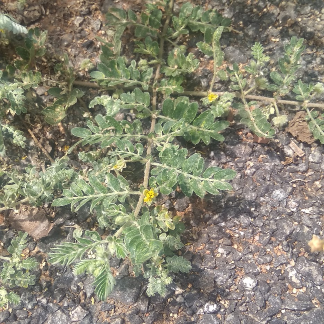
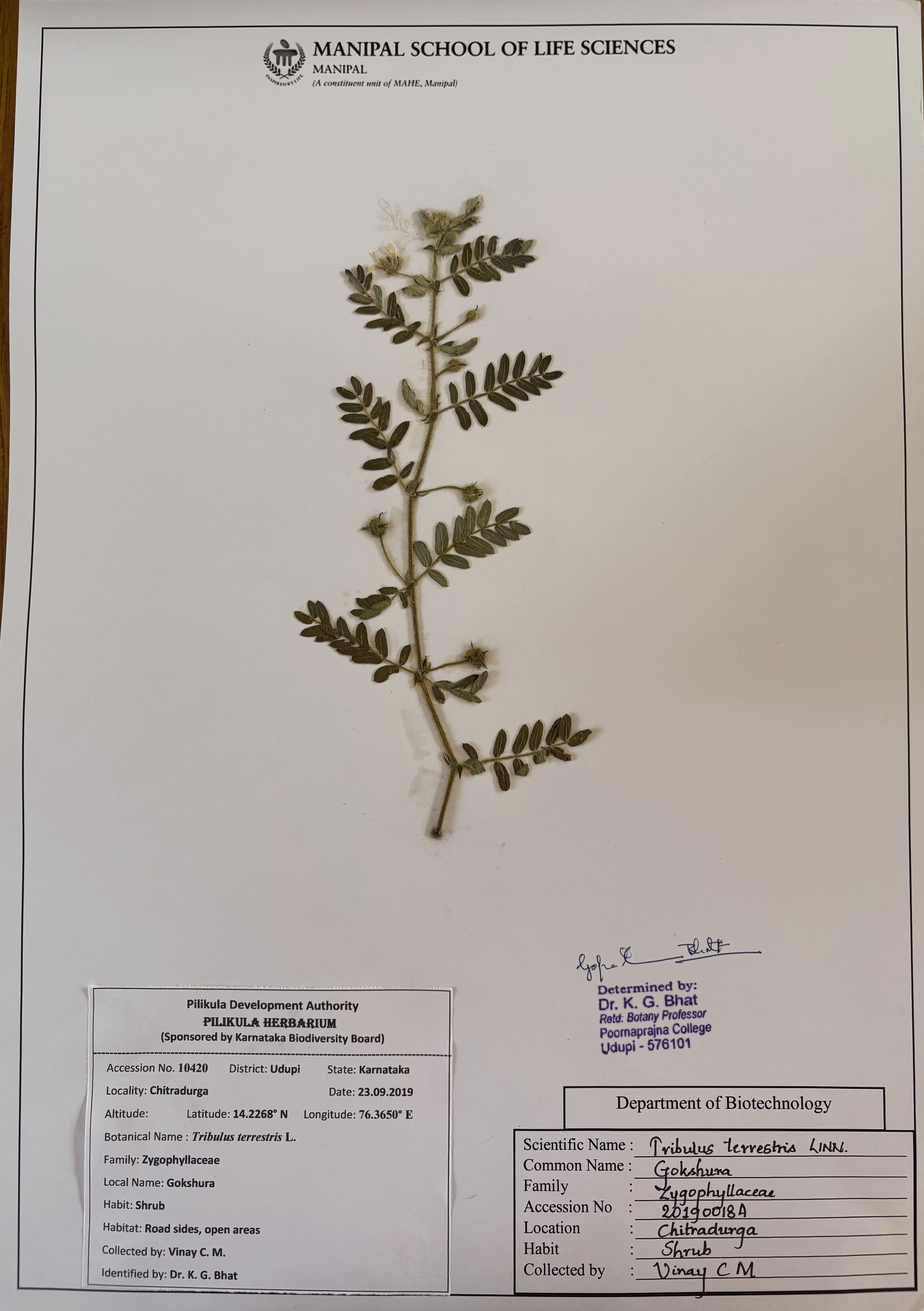
| Common name | Gokshura |
| Habit | Herb |
| Habitat | Open deciduous forests, wastelands and roadsides in black cotton soil areas |
| Parts used | Whole plant |
Synonyms
| Sr. No. | Synonyms |
|---|---|
| 1 | Hedysarum uniflorum Lapeyr. |
| 2 | Tribulus terrestris var. albidus Friv. |
| 3 | Tribulus terrestris prol. orientalis (A.Kern.) P.Graebn. |
| 4 | Tribulus terrestris subsp. orientalis (A.Kern.) Dostįl |
Taxonomical information
| Kingdom | Viridiplantae |
| Phylum | Streptophyta |
| Class | Magnoliopsida |
| Order | Zygophyllales |
| Family | Zygophyllaceae |
| Genus | Tribulus |
| Species | Tribulus terrestris L. |
Vernacular names
| Sanskrit | Gokshura |
| English | Small caltrops, Puncture vine |
| Hindi | Gokhru, Chhotaagokshru |
| Kannada | Neggilumullu, Neglu |
| Marathi | Sarate, Kate gokhru |
| Malayalam | Nerunji |
| Bengali | Gokshur |
| Tamil | Nerinzil, Nerunjee |
| Telugu | |
| Urdu | Khar-e-khasak khurd |
Morphology
Annual herb with branched tap root. The stems are up to 2 m long and radiating from the crown, often branching. Stem becomes erect in shade and usually prostrate. Leaves, 3-7 cm long, arranged sub-opposite, oblong-lanceolate leaflets. Flowers are 4 to 10 mm in diameter, silky, white or yellow in colour, solitary and borne from the leaf axils. Fruits are often woody with 1 cm in diameter containing 1-4 seeds. Seeds are yellow in colour, 2-5 mm long with variable in shape
Distribution
Globally found in Mediterranean, subtropical and desert climate regions around the world including India, China, Southern USA, Mexico, Spain, and Bulgaria. Within India, it is found in Assam, Bihar, Kashmir, Gujarat, Maharashtra, Punjab, Karnataka, Rajasthan, TamilNadu and Kerala
Medicinal uses
Aphrodisiac, Diuretic, Rheumatoid arthritis, hyperacidity, hernia, calculus, facial palsy, piles, heart disease, alopecia, fever, cough and diabetes
References
| 1 | Kalwij, J. M. (2012). Review of 'The Plant List, a working list of all plant species'. Journal of Vegetation Science, 23, 998-1002. |
| 2 | Akram, M., Asif, H. M., Akhtar, N., Shah, P. A., Uzair, M. U. H. A. M. M. A. D., Shaheen, G., ... and Ahmad, K. (2011). Tribulus terrestris Linn.: a review article. J Med Plants Res, 5, 3601-3605. |
| 3 | Joshi, V. K., Joshi, A., and Dhiman, K. S. (2017). The Ayurvedic Pharmacopoeia of India, development and perspectives. Journal of ethnopharmacology, 197, 32-38. |
| 4 | Vattakaven, T., George, R. M., Balasubramanian, D., Rejou-Mechain, M., Muthusankar, G., Ramesh, B. R., and Prabhakar, R. (2016). India Biodiversity Portal: An integrated, interactive and participatory biodiversity informatics platform. Biodiversity Data Journal, 4, e10279. |