
Compound details
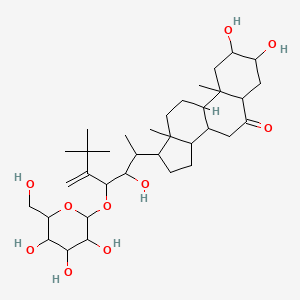
23-O-beta-D-Glucopyranosyl-25-methyldolichosterone
| Compound ID | CDAMM01524 |
|---|---|
| Common name | 23-O-beta-D-Glucopyranosyl-25-methyldolichosterone | IUPAC name | 2,3-dihydroxy-17-[3-hydroxy-6,6-dimethyl-5-methylidene-4-[3,4,5-trihydroxy-6-(hydroxymethyl)oxan-2-yl]oxyheptan-2-yl]-10,13-dimethyl-1,2,3,4,5,7,8,9,11,12,14,15,16,17-tetradecahydrocyclopenta[a]phenanthren-6-one |
| Molecular formula | C35H58O10 |
Experimental data
| Retention time | 10.83 |
|---|---|
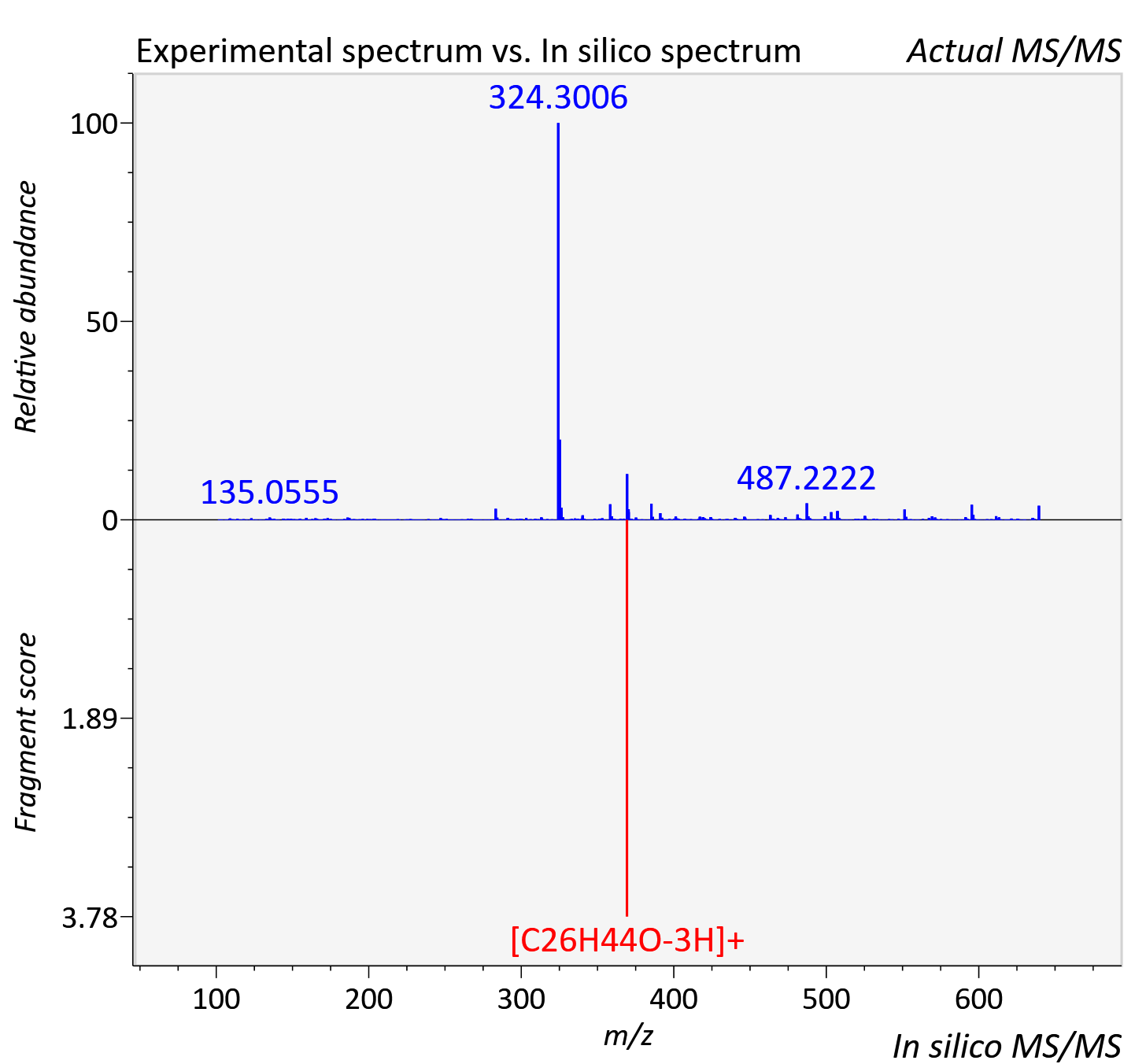
| Adduct | [M+H]+ |
| Actual mz | 639.419 | Theoretical mz | 639.41 |
| Error | 13.49 |
| Ionizaton mode | Positive |
| Instrument type | LC-MS/MS-QTOF, spectrum predicted by MS-DIAL v4.9 integrated with MS-FINDER 3.60 |
| Score | 5.95 |
Identifiers and class information
| Inchi key | NLNNWFCVCWSYSK-KZSJBWCONA-N |
|---|---|
| Smiles | O=C1CC2C3CCC(C(C)C(O)C(OC4OC(CO)C(O)C(O)C4O)C(=C)C(C)(C)C)C3(C)CCC2C5(C)CC(O)C(O)CC15 |
| Superclass | Lipids and lipid-like molecules |
| Class | Steroids and steroid derivatives |
Plant source
Pharmacokinetic properties
Compound-target network
Protein targets associated with phytocompound
| Uniprot ID | Gene name | Target name | TTD_ID | Prediction source |
|---|---|---|---|---|
| Q9UHC9 | NPC1L1 | Niemann-Pick C1-like protein 1 | T33901 | SEA |
| Q8TDU6 | GPBAR1 | G-protein coupled bile acid receptor 1 | T86273 | SEA |
| P05230 | FGF1 | Acidic fibroblast growth factor | T18639 | SEA |
| P60568 | IL2 | Interleukin-2 | T61698 | SEA |
| P14679 | TYR | Tyrosinase | T97035 | SEA |
Target associated diseases
| TTD_ID | Disease_ID | Disease name | ICD_11 | Uniprot ID | Gene names |
|---|---|---|---|---|---|
| T33901 | DI0188 | Hyper-lipoproteinaemia | [ICD-11: 5C80] | Q9UHC9 | NPC1L1 |
| T86273 | DI0417 | Type 2 diabetes mellitus | [ICD-11: 5A11] | Q8TDU6 | GPBAR1 |
| T18639 | DI0081 | Chronic arterial occlusive disease | [ICD-11: BD4Z] | P05230 | FGF1 |
| T18639 | DI0102 | Coronary atherosclerosis | [ICD-11: BA52] | P05230 | FGF1 |
| T61698 | DI0275 | Multiple sclerosis | [ICD-11: 8A40] | P60568 | IL2 |
| T61698 | DI0361 | Renal cell carcinoma | [ICD-11: 2C90] | P60568 | IL2 |
| T97035 | DI0007 | Acquired hypermelanosis | [ICD-11: ED60] | P14679 | TYR |
| T97035 | DI0008 | Acquired hypomelanotic disorder | [ICD-11: ED63] | P14679 | TYR |