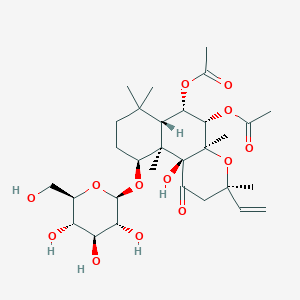
Forskoditerpenoside B


Compound IDCDAMM00284
Common nameForskoditerpenoside B
IUPAC name[(3R,4aR,5S,6S,6aS,10S,10aR,10bS)-5-acetyloxy-3-ethenyl-10b-hydroxy-3,4a,7,7,10a-pentamethyl-1-oxo-10-[(2R,3R,4S,5S,6R)-3,4,5-trihydroxy-6-(hydroxymethyl)oxan-2-yl]oxy-5,6,6a,8,9,10-hexahydro-2H-benzo[f]chromen-6-yl] acetate
Molecular formulaC30H46O13

Experimental data

Retention time55.822
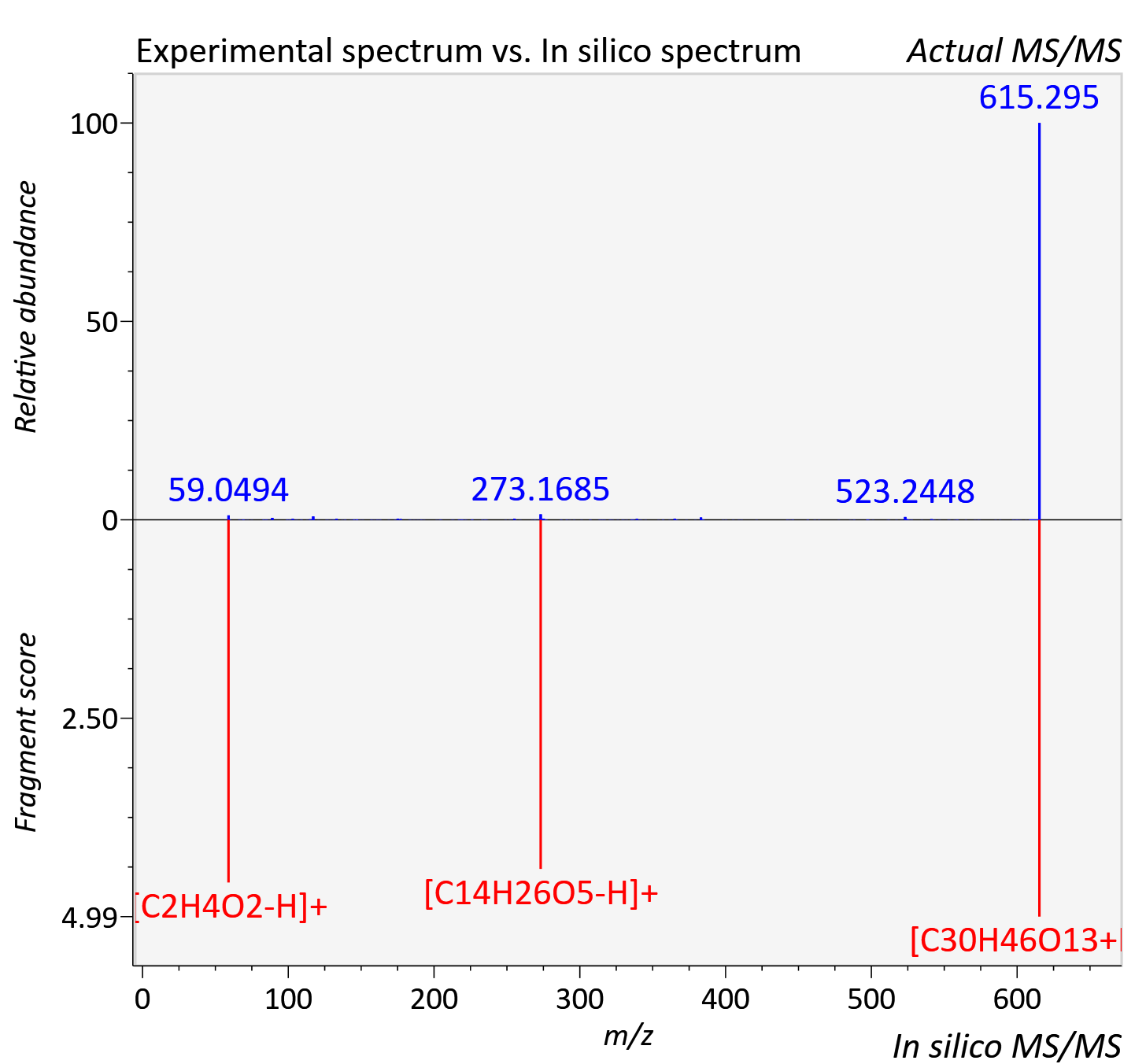
Adduct[M+H]+
Actual mz615.293
Theoretical mz615.301
Error13.51
Ionizaton modePositive
Instrument typeLC-MS/MS-QTOF, spectrum predicted by MS-DIAL v4.9 integrated with MS-FINDER 3.60
Score6.95

Identifiers and class information

Inchi keyKXMUHIKYMPFCHJ-XSFVSMFZSA-N
SmilesCC(=O)OC1C2C(CCC(C2(C3(C(=O)CC(OC3(C1OC(=O)C)C)(C)C=C)O)C)OC4C(C(C(C(O4)CO)O)O)O)(C)C
SuperclassOrganoheterocyclic compounds
ClassBenzopyrans

Plant source

  • Tribulus terrestris L.
  • Pharmacokinetic properties

    Number of descriptor values(#stars)1
    Number of non-conjugated amine groups (#amine)0
    Number of amidine and guanidine groups (#amidine)0
    Number of carboxylic acid groups (#acid)0
    Number of non-conjugated amide groups (#amide)0
    Number of rotatable bonds (#rotor)11
    Number of reactive functional groups (#rtvFG)3
    Predicted central nervous system activity (CNS)-2
    Molecular weight (mol_MW)614.686
    Computed dipole moment(dipole)6.442
    Total solvent accessible surface area (SASA)830.365
    Hydrophobic component of SASA (FOSA)572.627
    Hydrophilic component of SASA (FISA)225.715
    Pie component of the SASA (PISA)32.022
    Weakly polar component of the SASA (WPSA)0
    Total solvent accesible volume (volume)1717.94
    Number of hydrogen bond donors (donorHB)5
    Number of hydrogen bond acceptors (accptHB)17.7
    Free energy of solvation of dipole (dip^2/V)0.0241531
    Index of cohesive interaction in solids (ACxDN^.5/SA)0.0476639
    Globularity descriptor (glob)0.835413
    Predicted polarizability in cubic angstroms (QPpolrz)55.841
    Predicted hexadecane/gas partition coefficient (QPlogPC16)16.805
    Predicted octanol/gas partition coefficient (QPlogPoct)36.083
    Predicted water/gas partition coefficient (QPlogPw)25.801
    Predicted octanol/water partition coefficient (QPlogPo/w)0.973
    Predicted aqueous solubility (QPlogS)-3.651
    Conformation-independent predicted aqueous solubility (CIQPlogS)-4.564
    Predicted IC50 value for blockage of HERG K+ channels (QPlogHERG)-4.348
    Predicted apparent Caco-2 cell permeability in nm/sec (QPPCaco)71.688
    Predicted brain/blood partition coefficient (QPlogBB)-2.256
    Predicted apparent MDCK cell permeability in nm/sec (QPPMDCK)28.656
    Predicted skin permeability, log Kp (QPlogKp)-4.511
    PM3 calculated ionization potential (IP(ev))10.358
    PM3 calculated electron affinity (EA(eV))-0.455
    Number of likely metabolic reactions (#metab)7
    Prediction of binding to human serum albumin (QPlogKhsa)-0.453
    Predicted qualitative human oral absorption (HumanOralAbsorption)2
    Predicted human oral absorption on 0 to 100% scale (PercentHumanOralAbsorption)39.936
    Solvent-accessible surface area of fluorine atoms (SAFluorine)0
    Solvent-accessible surface area of amide oxygen atoms (SAamideO)0
    Van der Waals surface area (PSA)191.055
    Number of nitrogen and oxygen atoms (#NandO)13
    Number of violations of Lipinski’s rule of five (RuleOfFive)2
    Number of violations of Jorgensen’s rule of three (RuleOfThree)1

    Compound-target network

    Cytoscape Graph

    Protein targets associated with phytocompound

    Uniprot ID Gene name Target name TTD_ID Prediction source
    Q08828ADCY1Brain adenylate cyclase 1T63609SEA
    P51843NR0B1Orphan nuclear receptor DAX-1T23191SEA

    Target associated diseases

    TTD_ID Disease_ID Disease name ICD_11 Uniprot ID Gene names
    T63609DI0306Nutritional deficiency[ICD-11: 5B50-5B71]Q08828ADCY1

    Copyright © 2025